Blood Transfusions: How Small Compromises Can Lead to Sin

BibleLover

Well-known member
Joined
Mar 4, 2023
Messages
458
Reaction score
1,209
Part 1: Eve and the Beginning of Compromise

How does someone come to do something that they previously knew was wrong?

Does it usually happen all at once, or can it begin with seemingly small steps?

The account of Eve in Genesis offers an interesting starting point.

Satan did not begin by asking Eve to eat the forbidden fruit. He first questioned Jehovah's command:

"Did God really say that you must not eat from every tree of the garden?" (Genesis 3:1)

After challenging God's words, Satan suggested that Jehovah was withholding something desirable from her.

"For God knows that in the day you eat from it your eyes will be opened, and you will be like God, knowing good and evil." (Genesis 3:5)

Eve then looked at the fruit and saw that it was good for food, something desirable to look at and something to be desired to make one wise.

"When the woman saw that the tree was good for food, and that it was a delight to the eyes, and that the tree was desirable to make one wise, she took from its fruit and ate; and she gave also to her husband with her, and he ate." (Genesis 3:6)

Notice the progression. First came a challenge to Jehovah's word. Then came a different way of looking at the forbidden fruit. Finally, Eve acted on her own assessment rather than respecting Jehovah's command.

The fruit itself was not evil. It was good for food. But that did not give Eve the right to eat it. Jehovah had already established a boundary.

This illustrates an important principle:

Something can appear good, reasonable or desirable without being authorized by God.

Eve's experience also raises an important question.

Could a person gradually change the way he views a commandment until disobedience begins to seem reasonable?

We see a different but related progression in David's conduct involving Bathsheba. His initial desire led to further actions, including adultery, deception and ultimately the death of Uriah. Each subsequent action compounded the consequences of the previous one.

James later described how desire can develop into sin:

"Each one is tried by being drawn out and enticed by his own desire. Then the desire, when it has become fertile, gives birth to sin." (James 1:14, 15)

Of course, not every temptation leads to sin, and not every small decision is a compromise. The important distinction is whether we allow a desire to lead us across a boundary that Jehovah has established.

This principle deserves particular attention when we consider matters such as sexual morality and the use of blood. In both cases, a person may begin by questioning whether a restriction is really necessary. If personal desire or perceived benefit gradually takes precedence over God's instruction, it can become easier to justify conduct that once seemed unacceptable.

But there is a fundamental difference between examining a commandment to understand its meaning and looking for reasons to disregard it.

The question is not simply whether a particular action seems harmless or beneficial. It is whether our reasoning respects Jehovah's authority.

In the next post, we will examine how seemingly innocent situations can sometimes develop into compromises involving sexual morality, and why exercising self-control before reaching a boundary is so important.
 
Part 2: When Small Steps Lead to Sexual Immorality

In the previous post, we considered how Eve gradually came to view the forbidden fruit as desirable, eventually acting contrary to Jehovah's command. David's conduct involving Bathsheba also illustrated how one wrong decision can lead to increasingly serious consequences.

Could a similar progression occur in matters of sexual morality?

Jesus warned that sexual immorality does not necessarily begin with the physical act itself. At Matthew 5:28, he explained that a man who continues looking at a woman with lust has already committed adultery with her in his heart.

His words draw attention to something important: our actions are often preceded by changes in our thoughts and desires.

Consider a seemingly innocent situation. Two people who are attracted to each other begin meeting for coffee. There is nothing inherently wrong with having coffee together. However, if they deliberately cultivate romantic feelings, seek increasing emotional intimacy or begin concealing their meetings, they may gradually weaken boundaries that they originally intended to respect.

Each individual step might seem harmless when considered in isolation. Yet the direction in which those steps lead can become increasingly difficult to ignore.

This is why self-control is so important. Paul wrote:

"If they do not have self-control, let them marry, for it is better to marry than to be inflamed with passion." (1 Corinthians 7:9)

The principle is not that every expression of affection or every social interaction is dangerous. Rather, Christians need to recognize situations in which their desires may begin to control their decisions.

The same principle applies to other forms of temptation. When we repeatedly justify conduct that brings us closer to violating a commandment, we can gradually make that violation seem less serious.

There is also a danger in rationalizing our actions. We may tell ourselves that we can stop at any time, that our intentions are good or that a particular situation is an exception. But good intentions do not always protect us from the consequences of our decisions.

Paul expressed the importance of self-control:

"All things are lawful for me, but I will not let myself be brought under the power of anything." (1 Corinthians 6:12)

The ability to exercise self-control protects our freedom. By recognizing a dangerous direction early, we can avoid situations in which desire begins to dictate our behavior.

This brings us back to the lesson of Eve. The danger was not simply that she eventually ate the fruit. It was that she came to regard her own assessment as more important than Jehovah's clear instruction.

A small step is not necessarily a compromise. But repeatedly taking steps toward a boundary can make crossing it easier.

This principle raises an interesting question when we consider the Organization's changing position on blood.

Could a similar process of gradually relaxing boundaries occur when a previously prohibited practice becomes acceptable in smaller forms?


In the next post, we will examine the Organization's historical position on blood and compare it with its current policy on blood components.
 
Part 3: From Small Fractions to Major Blood Components

In the previous posts, we examined how seemingly small steps can gradually lead a person to disregard a boundary established by Jehovah. We also considered how this can happen in matters of sexual morality.

Could a similar process help us understand the changes in the Organization's position on blood?

For decades, we were taught that accepting a transfusion of whole blood or any of its four primary components—red blood cells, white blood cells, platelets and plasma—was unacceptable. The Organization regarded these components as covered by the biblical command to abstain from blood.

However, its position on smaller fractions began to change.


- The first significant change: blood fractions

In the June 15, 2000 issue of The Watchtower, the Organization explained that accepting fractions derived from the four primary components was a matter of individual conscience.

This meant that we could refuse a transfusion of plasma, for example, yet accept albumin, a protein derived from plasma. Similarly, certain clotting factors and immunoglobulins could be accepted according to one's conscience.

The distinction was based on the fact that these were smaller fractions rather than the primary components themselves.

At the time, however, the Organization continued to insist that accepting the four primary components was unacceptable.

In fact, in 2004, The Watchtower reaffirmed that position, explicitly stating that Witnesses refused transfusions of whole blood and all four primary components, while allowing individual decisions about fractions.


- The latest change: accepting the primary components

On September 18, 2026, the Governing Body announced another significant change.

We may now decide for ourselves whether to accept transfusions of red blood cells, white blood cells, platelets or plasma from another person. The prohibition on whole blood remains unchanged.

Consequently, a treatment that was previously considered unacceptable can now be accepted as a matter of individual conscience, provided it involves one or more of the primary components rather than whole blood.

This represents a substantial change in the practical application of the Organization's previous position.


- An important question about consistency

Consider the reasoning behind the earlier distinction. If the biblical command to abstain from blood meant that the four primary components could not be accepted, why were smaller fractions permitted as a matter of conscience?

And if the primary components are now also a matter of conscience, what principle establishes the boundary between whole blood, which remains prohibited, and the components that may now be accepted?

The Organization's current explanation emphasizes individual responsibility and the fact that Christians are not under the Mosaic Law. However, this raises a question about how the same biblical command was interpreted so differently over time.

We should distinguish between a change in policy and a change in the biblical text. Acts 15:28, 29 has not changed. What has changed is the Organization's application of that passage to medical treatments.


- Could gradual acceptance influence our conscience?

There is a psychological question worth considering here.

When someone has been taught for years that a particular action is unacceptable, a subsequent change allowing a smaller version of that action may alter how the person perceives the original restriction.

Once a practice is accepted in one form, accepting a more extensive form may no longer seem as significant. This is a possible example of incremental change, although we cannot assume that it explains every individual's response to the policy.

We should also recognize that the current policy explicitly leaves decisions about the primary components to individual conscience. Witnesses may still refuse them.

Nevertheless, the sequence of changes raises a legitimate question:

Can a gradual relaxation of previously established boundaries influence how people understand and apply their Bible-trained conscience?

The issue is not simply whether a particular medical treatment is beneficial or whether someone has a good reason to accept it. The deeper question is how we determine whether an action is consistent with God's commandments.

As we saw in the account of Eve, something can appear desirable and beneficial without that being sufficient reason to disregard a divine instruction.

And as we saw in the discussion of sexual morality, a series of individually small decisions can sometimes lead to conduct that a person originally intended to avoid.

The important lesson is not to condemn everyone who makes a different medical decision. Rather, it is to examine carefully the reasoning behind our decisions and avoid allowing convenience, pressure or changing expectations to replace our own sincere examination of Scripture.

In the next post, we will examine another important aspect of this issue:

When an organization leaves a decision to individual conscience, who ultimately bears responsibility for the decision and its consequences?


References

- The Watchtower, June 15, 2000, “Questions From Readers,” concerning blood fractions.

https://www.jw.org/en/library/magazines/w20000615/Questions-From-Readers/


- The Watchtower, June 15, 2004, “Be Guided by the Living God,” paragraphs 11–16.

https://www.jw.org/en/library/magazines/w20040615/Be-Guided-by-the-Living-God/


- Governing Body Update No. 2, 2026, and the announcement of September 18, 2026, concerning the use of primary blood components.

https://www.jw.org/en/library/series/more-topics/jehovahs-witnesses-view-blood/
 
When an organization leaves a decision to individual conscience, who ultimately bears responsibility for the decision and its consequences?
Over the years, I met enough people on the ministry who were damaged to one degree or another by their blood transfusions that they were in total agreement with our stand on it. If any brothers or sisters end up being damaged by having other people's blood transfused into them, I wonder who they will blame?
 
Part 4: From Divine Commandment to Personal Choice

One of the most significant aspects of the Organization's recent blood policy change is not simply what it now permits, but where it places responsibility.

For decades, Jehovah's Witnesses were taught that accepting whole blood or any of its four primary components violated God's command to abstain from blood (Acts 15:29). Now, accepting those components is a matter of individual conscience. But this change raises two important questions.

- Transferring responsibility

Consider the situation in Japan. The Organization has challenged government guidelines that allow intervention when parents refuse medically necessary blood transfusions for their children. Yet its representatives have also emphasized that parents, rather than congregation elders, are responsible for their children's medical decisions. This raises an important question:

Does transferring responsibility to parents and individuals also protect the Organization from potential legal liability?

We cannot establish that avoiding lawsuits was the Organization's motive. However, the practical effect of transferring responsibility is clear. When a decision is left to individual conscience, the institution can maintain that it did not direct the individual to accept or refuse treatment.

The consequences, however, remain with the individual and, in the case of children, potentially with their parents.

- The psychological effect of removing a prohibition

There is another, perhaps more subtle, consequence of this change.

Consider the difference between these two statements:

. "God commands you to abstain from blood."

. "You may decide for yourself whether to accept blood components."

The first establishes a clear religious boundary. The second presents a choice.

And when that choice involves preserving one's life, the natural desire to survive can exert enormous psychological influence.

A person who previously believed that accepting a particular component was disobedience to God may now reason that, since the Organization has left the decision to conscience, accepting it cannot necessarily be wrong.

In effect, a change in organizational policy can lead people to believe that a divine prohibition no longer applies, even though Acts 15:29 has not changed.

This is where the danger of gradual compromise becomes apparent. Once a clear boundary is replaced by personal discretion, it becomes easier to let convenience, fear or self-preservation determine the decision, without seriously considering what Jehovah requires.

Of course, personal conscience is important. But it is not a substitute for God's commandments. The question is not simply whether an organization permits a particular choice, but whether that choice is consistent with God's Word.

- A final question

Eve
did not need to be convinced that Jehovah's command was wrong. She only needed to be persuaded to look at the situation differently.

Could a similar process occur when a clear biblical prohibition is reclassified as a matter of personal conscience?

When an organization stops defining something as disobedience, do people necessarily stop considering whether it might still be disobedience to God?

Ultimately, our responsibility is not merely to follow an organization's latest policy. It is to maintain a clear conscience before Jehovah, even when doing so conflicts with our natural desires.
 
Part 5: Freedom of Choice: A Powerful Psychological Tool

There is a fascinating teaching technique that completely changes how we look at how policies shift—and it comes straight out of the classroom.

As teachers know, one of the best ways to get students to take ownership of their work without forcing them is by using the "strategy of choice." Instead of commanding a student to do something, you give them two options—usually one that’s harder and one that’s easier. Naturally, most choose the easier path. But in education, the motive is positive: it’s designed to help students build genuine autonomy and learn to take responsibility for their own decisions.

When an organization applies this exact same psychological trick, however, the motives and outcomes are completely inverted.

For decades, the stance on blood was presented as a non-negotiable divine command—right alongside abstaining from sexual immorality in Acts 15:29. But by reframing major blood components as a "matter of personal conscience," a clever psychological shift happens: the transfer of liability.

First, by calling it a "personal choice," the organization completely washes its hands of legal, moral, and emotional responsibility. If a member accepts blood components and experiences health complications, spiritual distress, or guilt, the institution can simply say, "We didn't tell you to do it; that was your own decision."

Second, the leadership understands human psychology. When faced with a choice during a life-or-death medical crisis—where one option is medical risk or death, and the other is now "permitted by conscience"—human nature will almost always default to the path of least resistance and self-preservation.

The deepest irony in all of this is the double standard. For generations, individual members were told to exercise radical faith—to risk their health, family relationships, and even their physical lives to uphold what was presented as an unyielding divine law. They were taught that trusting God meant refusing to compromise, no matter the cost.

Yet, when faced with modern legal lawsuits, financial liabilities, and public pressure, the institution itself chose corporate self-preservation. Instead of trusting that God would protect them through legal storms while holding fast to their long-held stance, they shifted the policy to safeguard their own interests.

In the end, it creates a tragic trickle-down effect: when followers see an organization compromise to protect its own survival, it implicitly teaches the members to do the exact same thing—putting convenience and physical survival ahead of uncompromised conviction.
That's why it's so much easier to study the Bible, learn about Jehovah and his requirements and just try to do them and stick with them, regardless of what ANYONE else says. Ok, we all fall down every now and then but just get back up again and continue moving forward. Honestly, those poor brothers and sisters being tossed and blown about all over the place because they haven't anchored themselves down, they're just bobbing along leaving the GB to sort their spiritual lives out.. madness, and totally dangerous. How they can even go out in the ministry now is beyond me, I mean, it's hard enough WITHOUT the GB keep throwing spanners in the works!!
 
That's why it's so much easier to study the Bible, learn about Jehovah and his requirements and just try to do them and stick with them, regardless of what ANYONE else says. Ok, we all fall down every now and then but just get back up again and continue moving forward. Honestly, those poor brothers and sisters being tossed and blown about all over the place because they haven't anchored themselves down, they're just bobbing along leaving the GB to sort their spiritual lives out.. madness, and totally dangerous. How they can even go out in the ministry now is beyond me, I mean, it's hard enough WITHOUT the GB keep throwing spanners in the works!!

I think you're absolutely right about needing to be anchored in Jehovah and his Word rather than being tossed around by organizational changes.

Something interesting occurred to me while thinking about the blood issue. The psychological mechanism can be very subtle. When an organization changes something that was previously presented as a clear command into a matter of personal choice, it doesn't have to tell someone to disobey. The person may simply conclude that there is no longer a command to obey.

That reminded me of Eve. Satan didn't tell her, “Disobey Jehovah.” He first questioned what Jehovah had commanded, then minimized the consequences, and finally encouraged her to make her own judgment about what was good.

There is a striking parallel in the way the blood issue can now be framed:

Previously:
“Jehovah commands Christians to abstain from blood, so accepting these primary blood components would be disobedience.”

Now:
“Whether you accept these primary blood components is a matter for your conscience.”

The medical circumstances haven't changed the wording of Acts 15:29. What has changed is how the command is interpreted and presented to the individual.

Once the decision is framed as:

“It's your choice.”

the person may naturally think:

“If it is my choice, then surely God has not forbidden it.”

Then another powerful factor enters the picture: self-preservation.

“It's my choice. I'm not violating a command. Medicine has advanced. This treatment may save my life.”

At that point, the person may not feel that he is choosing between obedience to God and preserving his life. He may believe he is simply making a legitimate medical decision.

That is the part I find particularly interesting about the parallel with Eve. Satan's approach did not require Eve to stop believing in Jehovah. He only needed to change how she understood Jehovah's command.

I'm not saying the Organization is consciously imitating Satan, nor that everyone who accepts a blood component is deliberately compromising. I'm comparing the psychological mechanism: a clear boundary can become less powerful when the person is persuaded that the boundary no longer really applies.

And that reinforces what you said: if our faith is anchored in Jehovah and His Word, we don't have to be tossed around every time an organization changes its interpretation.

We need to know what Jehovah says—not merely what someone tells us Jehovah says.
 
I'm not saying the Organization is consciously imitating Satan,
Ha! That's EXACTLY what I personally believe!! It's all soooo Garden of Eden!! In fact, all that the GB have been saying and doing the past few years is so Garden of Eden. I don't know how often you go to the meetings BL but have you noticed how LITTLE they mention Satan these days? In fact , I'd say for a good 20yrs now. It's almost as if they've buried him. Same with the blood issue, all the superior alternatives to blood, the marvellous work the HLC does, all total silence, for about 20yrs, and now this, all very suspicious. Brothers and sisters really do need to wake up and smell the coffee and start to see where the GB are leading them..
 
Ha! That's EXACTLY what I personally believe!! It's all soooo Garden of Eden!! In fact, all that the GB have been saying and doing the past few years is so Garden of Eden. I don't know how often you go to the meetings BL but have you noticed how LITTLE they mention Satan these days? In fact , I'd say for a good 20yrs now. It's almost as if they've buried him. Same with the blood issue, all the superior alternatives to blood, the marvellous work the HLC does, all total silence, for about 20yrs, and now this, all very suspicious. Brothers and sisters really do need to wake up and smell the coffee and start to see where the GB are leading them..
Wow, Proverbs! YOU ARE SOOO RIGHT! Come to think of it, I don't recall Satan being mentioned at all lately. Not in a long time — not like back in the day when we were constantly being warned about all his trickery.
 
Wow, Proverbs! YOU ARE SOOO RIGHT! Come to think of it, I don't recall Satan being mentioned at all lately. Not in a long time — not like back in the day when we were constantly being warned about all his trickery.
Yep, they used to teach us a real lot about Satan and all his shenanigans and how the whole world is lying in the power of the wicked one. When you think about it though, the power's that be HAD to get inside the org and stop all this revealing of truths or when it came to convid time these fraudulent GB people would not have been able to tell us the injections were from Jehovah 🧐🙄
 
Yep, they used to teach us a real lot about Satan and all his shenanigans and how the whole world is lying in the power of the wicked one. When you think about it though, the power's that be HAD to get inside the org and stop all this revealing of truths or when it came to convid time these fraudulent GB people would not have been able to tell us the injections were from Jehovah 🧐🙄
Yes, excellent points. I tried to type in on the website when satan was last mentioned in any of the literature. It seems it's been years but I cant believe that. Maybe I'm not typing in the right words. I"m curious now.
 
Ha! That's EXACTLY what I personally believe!! It's all soooo Garden of Eden!! In fact, all that the GB have been saying and doing the past few years is so Garden of Eden. I don't know how often you go to the meetings BL but have you noticed how LITTLE they mention Satan these days? In fact , I'd say for a good 20yrs now. It's almost as if they've buried him. Same with the blood issue, all the superior alternatives to blood, the marvellous work the HLC does, all total silence, for about 20yrs, and now this, all very suspicious. Brothers and sisters really do need to wake up and smell the coffee and start to see where the GB are leading them..
To be honest, I think there is something to what you are saying about Satan. I have noticed the same thing: he seems to receive remarkably little attention in the Organization compared with earlier decades.

But something else has struck me even more. The level of Scriptural and spiritual discussion in the publications seems to have been progressively reduced to a very basic level. Articles often explain what we should believe or do, but rarely explore the deeper reasoning behind it—especially the way Satan can use psychology, desires, assumptions, and subtle changes in thinking to deceive people.

That is interesting in light of Paul's words at Hebrews 5:12-14. After enough time, Christians should have been teachers and capable of taking solid food, but they still needed milk. Paul associated maturity with having their perceptive powers trained to distinguish both right and wrong.

It makes me wonder whether keeping spiritual discussions continually at a basic level can have an unintended—or perhaps more deliberate—effect: people become dependent on someone else to explain what everything means instead of developing the ability to examine matters deeply for themselves.

And that connects with another thing you mentioned. Why discourage people from reading outside material or pursuing higher education? Education obviously doesn't automatically produce wisdom, and university certainly has its dangers. But learning to investigate, compare sources, question assumptions and think critically can make a person less dependent on any single authority.

There is a certain irony here.

Satan's method in Eden involved controlling the way Eve evaluated information. He didn't simply give her a command. He introduced another interpretation, changed the frame of the question, and encouraged her to reach the conclusion herself.

So if people are kept from developing their own ability to examine evidence and reason from Scripture, they can become much easier to lead.

And that makes Jesus' words especially powerful:

“You will know the truth, and the truth will set you free.” — John 8:32

Truth doesn't need to be protected from honest examination. If something is true, deeper examination should ultimately strengthen it.

Perhaps that's why spiritual maturity is so important. Jehovah doesn't want us merely to know the answers. He wants us to develop perceptive powers so that we can recognize deception when it comes.
 
Definitely, I rarely learn anything new at the meetings these days..
Yes, and interestingly, I think there is a prophecy that may fit what we are describing.

“Look! The days are coming,” declares the Sovereign Lord Jehovah, “when I will send a famine into the land, not a famine for bread or a thirst for water, but for hearing the words of Jehovah.” Amos 8:11

And verse 12 says that people would search for Jehovah's word but not find it. The immediate context is judgment on Israel, that might apply to the Organization today. The principle is certainly interesting when we see a situation where there is plenty of religious material, meetings and publications, yet relatively little deep spiritual food.

And there is an irony here that I find fascinating. Perhaps one reason some of us ended up researching and thinking for ourselves is precisely because we weren't getting enough solid food.

Paul said at Hebrews 5:12-14 that Christians who had been around long enough should have been teachers, but still needed milk. He then says that solid food belongs to mature people whose perceptive powers have been trained through use.

In other words, spiritual maturity requires exercise. You can't develop strong spiritual muscles if someone continually does all the thinking for you.

That also makes me think of Paul's illustration at 1 Corinthians 3:11-13. He speaks about building on the proper foundation, but then says that different materials can be used—gold, silver, precious stones, wood, hay and stubble—and that fire will reveal what sort of work has actually been built.

There is something almost ironic about this. If we're continually given only basic material, we may eventually start looking for the deeper things ourselves. We begin digging into the Scriptures, comparing passages, examining history, asking questions and testing what we're being told. And perhaps that process itself can make our spiritual house stronger.

Jesus' illustration in Matthew 7:24-27 makes the point beautifully. The wise man didn't merely hear Jesus' words; he acted on them and built his house on rock. Then the rain came, the floods came and the winds beat against the house—but it stood.

So maybe the important question isn't simply “How much spiritual food am I being given?” but:

“What am I building with what I have received?”

If our foundation is really Jehovah and his Word, perhaps even disappointing spiritual circumstances can have an unexpected result: they can force us to dig deeper.

And when the storm finally comes, it won't matter how impressive the house looked from the outside. What matters will be what it was actually built on.
 
Look! The days are coming,” declares the Sovereign Lord Jehovah, “when I will send a famine into the land, not a famine for bread or a thirst for water, but for hearing the words of Jehovah.” Amos 8:11
Exactly this! It HAS to be referring to inside Jah's org because the world in general are having a mighty feast! Ok, it might be nearly all junk food but they've got plenty and aren't going hungry!! Inside Jah's org they're hardly heating any words from Jehovah, it's all "the GB have decided" this, that and the other..
 
Part 6: Satan's Choice Architecture: From Eden to the Blood Issue

It's interesting to compare Satan's deception with the way the Organization now presents the blood issue. The striking similarity is not simply that both involve choice, but the sequence of reasoning that could lead someone from Jehovah's command to a decision that contradicts it.

1. The prohibition is reframed

Satan: “Did God really say that you must not eat from every tree of the garden?” (Genesis 3:1)

The Organization: “Did God really say that you must abstain from blood components? Is Acts 15:29 really meant to prohibit them?”


2. The consequences are minimized

Satan: “You certainly will not die.” (Genesis 3:4)

The Organization: “We shouldn't go beyond what is written. Modern medicine has advanced, and blood transfusions are becoming less common.”


3. You are encouraged to evaluate the matter independently

Satan: “You will be like God, knowing good and evil.” (Genesis 3:5)

The Organization: “It's a matter of personal conscience.”


4. The desirable outcome becomes the focus

Eve: “Consequently, the woman saw that the tree was good for food, that it was something desirable to the eyes, yes, the tree was pleasing to look at... ” (Genesis 3:6)

The Witness: “I can accept these blood components, survive and continue serving Jehovah. Besides, Jehovah forbade blood transfusions, but perhaps not its individual components. In fact, life is sacred to Jehovah, so I must do everything I can to preserve mine. My family needs my support, and Jehovah surely wouldn't want me to die if there is a treatment that could save my life."


5. The choice is made

Eve: “She took from its fruit and ate; and she gave also some to her husband when he was with her, and he ate it.” (Genesis 3:6)

The Witness: “I will accept blood components.”


The contrast between Jehovah's way and Satan's approach is striking.

Jehovah's way: Respect his authority, obey his commands and accept the limitations he establishes.

Satan's approach: Focus on what you desire, question the restrictions and exercise your freedom to decide for yourself what is good.

The deception in Eden was that freedom was presented as independence from Jehovah. Yet the result was not greater freedom, but slavery to sin.

Of course, the ability to choose is not itself the problem. Jehovah gave humans free will. The real issue arises when freedom is used as a justification for disregarding or reinterpreting a divine command.

There is an important question to consider here: Could a change in how a command is presented make disobedience appear to be an entirely legitimate personal choice?

The most subtle deception may not be convincing someone to disobey Jehovah, but convincing that person that there is no command to disobey in the first place.
 
Last edited:
Part 7: Vaccines: from prohibition, to personal conscience, to institutional promotion

There is a striking historical pattern in how the Organization shift over time, and if we look back at the archives, the blood issue isn’t the first time we’ve seen it.

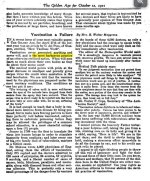
Back in the October 12, 1921 issue of The Golden Age (which later became Awake), the Watchtower Organization took an absolute, unyielding stance against vaccines, labeling them "the most barbarous practice."

- Death and uncleanness in the Bible

Several passages associate contact with dead bodies with ritual uncleanness.

Numbers 19:11: Anyone who touched a dead human body became unclean for seven days.

Leviticus 11:39-40: Touching the carcass of certain animals also made a person unclean.

Deuteronomy 14:21: Israelites were forbidden to eat an animal that had died naturally.

These laws demonstrate that Jehovah made a distinction between life and death and established restrictions concerning contact with dead organisms.

- Why did Jehovah establish these restrictions?

The laws concerning corpses were part of a broader system that taught the Israelites to respect holiness and recognize the consequences of death.

For example, Leviticus 17:11 says that the life of the flesh is in the blood. Numbers 19, meanwhile, establishes a specific purification procedure for someone who comes into contact with a corpse.

If Jehovah prohibited certain uses of blood and established purification requirements for contact with the dead, what principles, if any, should Christians apply when deciding whether to introduce biological substances into their bodies?

The logic was presented in 1921 as simple: introducing dead, diseased biological matter into the human bloodstream was a direct violation of God’s laws on bodily purity.

For decades, members held to this as a non-negotiable divine boundary. But by 1952, the policy quietly shifted. Suddenly, vaccines were no longer a "barbarous" sin; they were reframed as a "matter of personal conscience."

However, the Organization didn't stop at making it a "conscience matter." In recent years, the pendulum swung to the complete opposite extreme. During the pandemic, in Governing Body Update #9 (2021), the leadership actively promoted the COVID-19 vaccine, even employing emotional and spiritual persuasion by framing getting vaccinated as a way to "remain in the land of the living."

Furthermore, they instituted mandatory vaccination policies for Bethel volunteers worldwide—effectively turning what was once labeled a "barbarous practice" into a requirement for full-time institutional service.

When you trace this complete trajectory—from an absolute ban based on "dead matter," to a "personal choice," to an outright institutional mandate—the blueprint is virtually identical to the strategy Satan used with Eve in Genesis 3:

1. Questioning the Original Command: Satan began by planting doubt: "Did God really say...?" Similarly, the reasoning shifts from an absolute prohibition ("God forbids this biological practice") to questioning the scope of the rule ("Is it really meant to prohibit this specific application?").

2. Minimizing the Consequences & Reversing the Fear:
In Eden, the serpent declared, "You certainly will not die." Here, the fear of violating a divine law on biological purity was replaced with the fear of physical death, urging members to comply to "stay in the land of the living."

3. Reframing Obedience as Convenience and Mandate:
Satan promised, "You will be like God, knowing good and evil"—shifting the authority from God's explicit law to human self-determination and institutional authority. By first making it "conscience" and later enforcing it for Bethelites, human authority superseded the original theological premise.

4. Focusing on the Desirable Outcome:
Eve saw that the fruit was "desirable." Whether it's "health" , organizational approval, or remaining in full-time service, the focus shifts entirely to "practical survival" and institutional compliance, making the compromise feel logical and spiritual.
The irony here is profound. When an institution claims a practice violates God's laws on purity or life—whether it's dead matter in 1921 or primary blood components today—and then continuously shifts the goalposts from prohibition, to personal conscience, to institutional promotion, it exposes the original claim.
If something is a direct commandment from God, human leaders do not have the authority to downgrade it to an option, nor do they have the right to mandate what God's Word left as a prohibition. By constantly manipulating the boundary lines, the Organization manages its own public and legal standing, leaving individual believers to navigate the spiritual and physical fallout of these ever-shifting mandates.
 

Attachments

  • IMG_20261001_115951.jpg
    IMG_20261001_115951.jpg
    331.9 KB · Views: 42
Part 7: Vaccines: from prohibition, to personal conscience, to institutional promotion

There is a striking historical pattern in how the Organization shift over time, and if we look back at the archives, the blood issue isn’t the first time we’ve seen it.

Back in the October 12, 1921 issue of The Golden Age (which later became Awake), the Watchtower Organization took an absolute, unyielding stance against vaccines, labeling them "the most barbarous practice."

- Death and uncleanness in the Bible

Several passages associate contact with dead bodies with ritual uncleanness.

Numbers 19:11: Anyone who touched a dead human body became unclean for seven days.

Leviticus 11:39-40: Touching the carcass of certain animals also made a person unclean.

Deuteronomy 14:21: Israelites were forbidden to eat an animal that had died naturally.

These laws demonstrate that Jehovah made a distinction between life and death and established restrictions concerning contact with dead organisms.

- Why did Jehovah establish these restrictions?

The laws concerning corpses were part of a broader system that taught the Israelites to respect holiness and recognize the consequences of death.

For example, Leviticus 17:11 says that the life of the flesh is in the blood. Numbers 19, meanwhile, establishes a specific purification procedure for someone who comes into contact with a corpse.

If Jehovah prohibited certain uses of blood and established purification requirements for contact with the dead, what principles, if any, should Christians apply when deciding whether to introduce biological substances into their bodies?

The logic was presented in 1921 as simple: introducing dead, diseased biological matter into the human bloodstream was a direct violation of God’s laws on bodily purity.

For decades, members held to this as a non-negotiable divine boundary. But by 1952, the policy quietly shifted. Suddenly, vaccines were no longer a "barbarous" sin; they were reframed as a "matter of personal conscience."

However, the Organization didn't stop at making it a "conscience matter." In recent years, the pendulum swung to the complete opposite extreme. During the pandemic, in Governing Body Update #9 (2021), the leadership actively promoted the COVID-19 vaccine, even employing emotional and spiritual persuasion by framing getting vaccinated as a way to "remain in the land of the living."

Furthermore, they instituted mandatory vaccination policies for Bethel volunteers worldwide—effectively turning what was once labeled a "barbarous practice" into a requirement for full-time institutional service.

When you trace this complete trajectory—from an absolute ban based on "dead matter," to a "personal choice," to an outright institutional mandate—the blueprint is virtually identical to the strategy Satan used with Eve in Genesis 3:

1. Questioning the Original Command: Satan began by planting doubt: "Did God really say...?" Similarly, the reasoning shifts from an absolute prohibition ("God forbids this biological practice") to questioning the scope of the rule ("Is it really meant to prohibit this specific application?").

2. Minimizing the Consequences & Reversing the Fear:
In Eden, the serpent declared, "You certainly will not die." Here, the fear of violating a divine law on biological purity was replaced with the fear of physical death, urging members to comply to "stay in the land of the living."

3. Reframing Obedience as Convenience and Mandate:
Satan promised, "You will be like God, knowing good and evil"—shifting the authority from God's explicit law to human self-determination and institutional authority. By first making it "conscience" and later enforcing it for Bethelites, human authority superseded the original theological premise.

4. Focusing on the Desirable Outcome:
Eve saw that the fruit was "desirable." Whether it's "health" , organizational approval, or remaining in full-time service, the focus shifts entirely to "practical survival" and institutional compliance, making the compromise feel logical and spiritual.
The irony here is profound. When an institution claims a practice violates God's laws on purity or life—whether it's dead matter in 1921 or primary blood components today—and then continuously shifts the goalposts from prohibition, to personal conscience, to institutional promotion, it exposes the original claim.
If something is a direct commandment from God, human leaders do not have the authority to downgrade it to an option, nor do they have the right to mandate what God's Word left as a prohibition. By constantly manipulating the boundary lines, the Organization manages its own public and legal standing, leaving individual believers to navigate the spiritual and physical fallout of these ever-shifting mandates.
Great info Bible lover...keep digging. 👍
 
Part 8: How Might Satan Have Deceived the Angels?

Genesis 6:1-4
gives us a remarkably brief account. It tells us that the sons of the true God noticed that the daughters of men were beautiful, took wives for themselves, and produced offspring.

But how could Satan have persuaded intelligent spirit creatures to abandon their proper position?

The Bible doesn't tell us what conversations took place. Nevertheless, we do know something about Satan's method with Eve.

In his conversation with Eve, he did not simply say, “Rebel against Jehovah.” He questioned God's command, appealed to desire, minimized the consequences and encouraged Eve to make her own judgment.

Below is a speculative dialogue between Satan and the angels in heaven, generated by Gemini, exploring how the persuasion to cross biblical boundaries might have unfolded:"

Setting: A realm beyond physical vision. A group of heavenly beings watches the unfolding human world below.

- Satan: “Look at them. Look at how freely they experience creation. The sensation of touch, the warmth of flesh, the thrill of desire. God gave them a world of tangible, physical pleasure… and what did He give you? A realm of silent, endless obedience.”

- Angel 1: “Our place is in the heavens. We were created for the presence of the Creator, to carry out His word. The physical realm belongs to the earthling.”

- Satan: “And who marked that boundary? Why should you be restricted to observing from a distance? Look closer at the daughters of men. Notice their beauty, their form, the way they move. You possess the power to materialize, to step into their world and take physical bodies. Why hold a power you are forbidden to use?”

- Angel 2: “Because it violates the order of creation. To leave our proper dwelling place to join with flesh… it goes against what we were made for.”

- Satan: “Is it truly a violation, or simply an unexplored capability? Did God give you the power to take physical form just so you could ignore it? Look at them again. Is there any real harm in experiencing what He created? You wouldn't be destroying anything—you would simply be enjoying it.”

- Angel 3: “If we were to do this… if we were to take human form and dwell among them… the consequences would be severe. The Creator’s law is clear.”

- Satan: “Consequences? You are immortal beings, powerful spirits! Will the Creator destroy His own heavenly hosts over a matter of personal experience? Besides, look around you. You are not alone in thinking this. Why should one of you take the risk when you can all step across the line together? If all of you choose it, who stands condemned?”

- Angel 1:(Looking lower, fixating on the physical world) “They really are remarkably beautiful... To feel what they feel, even for a moment...”

- Satan: “Then stop denying yourselves. The boundary is only real as long as you refuse to cross it. Step down, take the bodies you have the power to form, and take the life you want.”


The Mechanics of the Dialogue

Notice how the progression mirrors the exact same strategy of deception:

1. Creating a Sense of Restriction: Satan begins by making them feel deprived ("What did He give you?").

2. Focusing on the Forbidden Object: He directs their gaze until fascination replaces duty ("Look closer at the daughters of men").

3. Questioning the Purpose of the Law: He reframes God's boundaries as arbitrary limitations ("Why hold a power you are forbidden to use?").

4. Safety in Numbers: He uses collective compromise to erase individual accountability ("If all of you choose it, who stands condemned?").

Once the angels allowed curiosity to become fixation, the leap from heavenly duty to earthly materialization became a friction-free choice.
 
Thanks @Spoilmerotten. We can go even further by imagining the conversation among the angels after they were deceived by Satan, showing how small compromises—looking at women, talking with them, and making excuses—gradually led them to sin: taking women as wives."

Below is a speculative dialogue generated by Gemini:

The Angels' Descent Through Small Compromises

Setting: On the slopes of Mount Hermon, prior to taking physical bodies. A group of angels gather, having already entertained Satan's initial suggestions. The boundary of heaven has not yet been crossed, but their gaze is now fixed downward.

**Angel A:** "Did you see her near the spring today? I materialized just long enough to observe from behind the trees. Her beauty, her voice... there is a warmth in human life that standard heavenly duty simply doesn't offer."

**Angel B:** "You materialized just to look? We were sent to observe and minister, not to linger in physical forms for our own satisfaction. Looking at them like that feels... dangerous."

**Angel A:** "Is looking really a sin? God created human beauty, didn't He? Appreciating the Creator's handiwork up close isn't a violation. I didn't touch her; I simply spoke a few words to her in passing. She answered with such gentle grace."

**Angel C:** "He has a point. Where does the law actually say we cannot speak to them? We are simply learning about the creation we were assigned to watch over. It makes us better guardians if we understand their feelings and their nature."

**Angel B:** (Hesitating) "Talking with them is one thing... but you are letting your mind dwell on her. The way you speak of her goes beyond guardianship. If we stay down here, near them, taking physical form will become second nature to us."

**Angel A:** "And what if it does? Look at the state of mankind—they are fragile, short-lived, and full of sorrow. If we step into their world fully, if we take them as wives and live alongside them, we could guide them, protect them, and give them stronger offspring. We wouldn't be rebelling; we would be improving their existence!"

**Angel C:** "Yes! It is an act of benevolence, not rebellion. Why should such beauty be left to perish in a brief human lifetime when we can share our strength with them?"

**Angel B:** *(Looking down at the village below, letting his own gaze linger)* "When you put it that way... it almost sounds noble. If all of us do this together, if we bind ourselves by an oath so no single one of us stands alone, then who can say we acted out of malice?"

**Angel A:** "Then it is decided. No more watching from a distance. Tonight, we take physical flesh permanently, choose the ones we desire, and make them our wives."

The Chain of Events: How Small Compromises Led to the Fall

This dialogue illustrates the classic spiritual trajectory of incremental compromise. The fall of these heavenly beings did not begin with the act of taking human wives; it was the final result of a chain of small, self-justified concessions:

1. The Idle Gaze (Unchecked Looking):
The angels moved from performing their assigned duties to fixing their attention on what was forbidden. By lingering to look at human beauty, curiosity replaced devotion.

2. The First Contact (Innocent Conversation):
They rationalized stepping slightly closer—just to "talk" or "understand human nature." This small step broke the formal distance between heavenly ministers and earthly creatures.

3. The Spiritual Excuse (Noble Rationalization):
To quiet their conscience, they reframed their selfish desire as an act of goodness. They convinced themselves that taking wives would "help" mankind and "improve" creation, masking disobedience under the guise of benevolence.

4. Group Consensus (Safety in Numbers):
By discussing it among themselves and agreeing to act together, they eroded individual guilt. If everyone is compromising, the compromise feels normal and safe.

5. Full-Scale Transgression (Taking Wives):
Having justified the looking, the talking, the desire, and the excuses, the final step—leaving their proper dwelling place and taking physical wives (Genesis 6:2)—felt like a natural, friction-free conclusion.
 
The collapse of the WT doctrine on blood demonstrates the validity of Satan's lie in Eden - "For God knows that when you eat from it your eyes will be opened, and you will be like God, knowing good and evil.” We don't know between good and evil without God, without God we pontificate.
 
The collapse of the WT doctrine on blood demonstrates the validity of Satan's lie in Eden - "For God knows that when you eat from it your eyes will be opened, and you will be like God, knowing good and evil.” We don't know between good and evil without God, without God we pontificate.
Thanks @SollaSollew. I think the Pharisees give us perhaps the clearest example of what can happen after a person or religious system begins deciding which parts of God's requirements really matter.

Jesus said:

“You give a tenth of the mint and the dill and the cumin, but you have disregarded the weightier matters of the Law—the justice and the mercy and the faithfulness.” — Matthew 23:23

Notice the progression.

They were extremely concerned about certain religious details, yet they neglected justice, mercy and faithfulness.

Then Jesus showed something even more serious. Their traditions could actually override God's commandments (Mark 7:8-13). They became concerned with appearing righteous before men while their hearts were becoming corrupt.

And where did that eventually lead?

They rejected the Messiah himself. Jesus told them:

“You are from your father the Devil.” — John 8:44

He then connected their attitude with lying and murder. That's the part that really makes me think.

A compromise may look small when it begins. But the danger isn't necessarily the size of the first compromise. It is the direction in which it takes us.

First, we find a reason why one command doesn't quite apply. Then another command becomes negotiable. Then human reasoning or tradition becomes more important than God's Word.

Eventually, a person can become extremely strict about religious details while simultaneously violating the very qualities Jehovah considers most important.

The Pharisees show that the final result can be much more serious than the original compromise.

So when we discuss the blood issue, perhaps the question shouldn't be only:

“Is accepting this particular component really wrong?”

We should also ask:

“What happens to our relationship with Jehovah when we become accustomed to deciding for ourselves which of his commands remain binding?”

That's why small compromises deserve so much attention.

The danger isn't merely crossing one line. The danger is becoming the kind of person who no longer recognizes Jehovah's lines as boundaries.
 
Part 9: Acts 15:29 — Fornication and blood: When Desire Becomes Your Master

Let's first consider how sexual immorality can gradually make a person a slave to his own desire.

Imagine a man who cannot control his sexual desire before marriage. He has sex with his girlfriend, even though he knows Jehovah's standard. Perhaps he tells himself:

“We love each other. We're going to get married anyway. What's the harm?”

He crosses the line. Eventually, they marry. For a while, everything seems fine. But after a couple of years, married life becomes routine.

Then he meets another woman at work.
At first, there is nothing wrong. They simply talk about ordinary things—work, family, everyday problems.

Then one day he starts telling her about his marriage. He tells her how unhappy he is and how “toxic” his wife is. The other woman listens. She is kind, understanding and interested in what he has to say. Soon he begins thinking:

“She understands me better than my wife does.”

Nothing physical has happened yet. But something has already changed. He is no longer simply talking to a coworker. He is cultivating an emotional attachment.

They begin looking forward to seeing each other. Their conversations become more personal. They start sharing things they don't tell their spouses. Then comes another apparently small step:

“Why don't we have a coffee after work?”

There is nothing wrong with having coffee. But now they are deliberately creating an opportunity to be alone together and deepen a relationship that should not be developing.
One thing leads to another. Eventually, they have sex. Now another boundary has been crossed.

Then comes divorce. There are legal expenses, the division of property, two households instead of one, and financial difficulties that follow.

Children are caught in the middle. They may now live between two homes, see less of their father, or grow up without the daily guidance and stability that a united family once provided.

There can be loneliness, resentment, guilt and emotional wounds—not only for the man and the two women, but for children and other family members who never chose any of this.
And the man enters another relationship. Then another sexual relationship. And eventually another marriage.What has happened?

The problem was never simply one sexual act. There was a progression:

desire > justification > emotional attachment > opportunity > sexual immorality > divorce > financial and family consequences > another relationship > more sexual immorality.

Each step made the next one easier. And the consequences can become much larger than the original desire.

What began as: “I just want to be happy” can end in broken families, financial hardship, damaged relationships, loneliness, guilt and children carrying wounds they did nothing to create.

The man may have started by thinking:

“I can control my desires.”

But eventually the reality is the opposite:

His desires are controlling him.

He has become a slave to his sexual desire.
And there is an enormous irony in that. He pursued what he believed would give him freedom and happiness, but that “freedom” has brought consequences that can restrict his life for years.

What he thought would make him happy has become his master—and the price is paid not only by him.

This is why James 1:14-15 is so powerful. It doesn't describe sin as appearing suddenly out of nowhere. Desire entices, desire conceives, and eventually it gives birth to sin.

The final act is only the visible part of the process. The process began much earlier—when he first allowed his desire to move him toward a boundary Jehovah had established.

And that raises an important question:

Could the same principle operate when the Organization repeatedly makes compromises in order to protect something it desires?

That will be considered in the next post
 
Top